Gravel to Asphalt Driveway Conversion in Tampa, FL
An unpaved drive of limerock, shell, crushed concrete or gravel can often become the foundation for asphalt. Here is how a conversion works, what the existing stone can and cannot do, and the drainage details that matter most on flat, wet ground.
Call (656) 208-2400 for a Free Estimate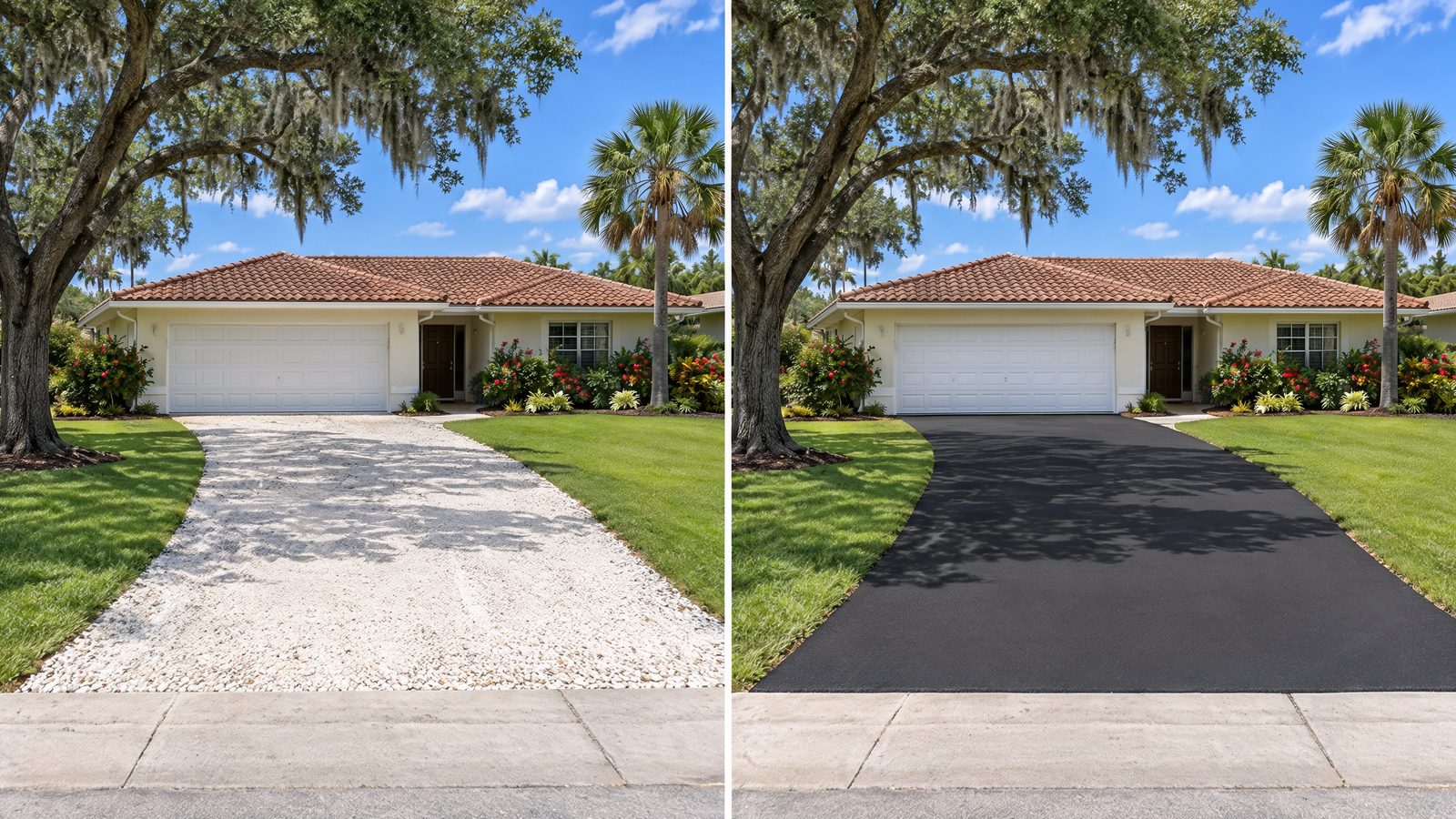
Plenty of driveways around Hillsborough County were never paved. Older homes, rural lots and long private lanes are often surfaced with limerock, crushed shell, crushed concrete or gravel. These drives are cheap to build, but they rut in summer storms, wash out at low spots, track dust and stone into the house and need fresh material every few years.
Converting to asphalt solves most of that, and the stone already on the drive is not wasted. Years of traffic have packed it down, and with the right preparation it can become part of the base for the new pavement. Whether it can, and how much needs to be added, is the first question a conversion has to answer.
This page explains how that evaluation works, the grading and drainage that make or break a conversion on flat land, the extra steps a long rural drive needs and the situations where staying unpaved is the smarter choice.
Can the Existing Stone Become the Base?
Often it can, at least in part. A limerock or crushed concrete drive that has carried cars for years may already be dense and well graded. The way to find out is to dig test holes in a few places and probe the low spots. What you are looking for is a consistent layer of firm, angular stone without much sand, soil or organic material mixed in.
Problems show up as thin stone over loose sand, pockets of mud or organic material where water sits, round pea gravel that rolls instead of locking together, or shell that has broken down into fine powder. Those areas need to be dug out or built up with new aggregate. Where the existing material is sound, it is reshaped, topped up where it is thin, moistened and compacted with a roller until it no longer moves underfoot.
The goal is a uniform base across the whole drive. A conversion that paves over a mix of solid stone and soft spots will crack along the boundaries between them, usually within a season or two.
Grading and Crown on Flat Ground
Unpaved drives often drain because water soaks through the stone. Asphalt changes that. Rain now runs off the surface, so the drive has to be shaped to send it somewhere useful. On most Tampa lots the land is nearly flat, which means the slope has to be built in deliberately.
Long drives are commonly built with a slight crown, higher in the middle and lower at both edges, so water sheds to the sides instead of running down the length of the drive and collecting at the bottom. Shorter drives are usually sloped toward the street or to a swale. Either way, the grade is set in the base before any asphalt goes down, and it is worth checking with a laser or string line, because small errors on flat ground create long-lasting puddles.
Where the water goes after it leaves the pavement matters just as much. Edges need a shoulder of soil or stone to carry runoff away without eroding, and low points along the drive may need a small swale or a pipe so water does not pond against the asphalt edge.
The Roadside Ditch and Culvert
Many rural and older drives cross a roadside ditch with a culvert pipe where they meet the street. A conversion is the time to check that pipe. Crushed, rusted or silted culverts back water up onto the drive and the road, and a pipe that was undersized or set at the wrong level will cause trouble for the new pavement too.
The ditch and the strip next to the road are usually in the public right-of-way. In unincorporated areas such as Lutz and much of the east county that means Hillsborough County; inside Tampa, Temple Terrace or Plant City it means the city; and on a state road it means the state. Replacing a culvert or paving the connection often requires a right-of-way permit, and the agency may specify the pipe size, material and end treatment. Calling them before the work is scheduled avoids redoing the apron later.
Long Rural Drives in Lutz and Plant City
North and east county properties often have drives that run a long way from the road to the house, barn or packing building. Length changes the plan. The quantity of stone and asphalt rises with every foot, so getting the base right is the biggest factor in how well the money is spent. Some owners pave the full length; others pave the area near the house and garage and leave the outer run in stone.
Use matters as much as length. A drive that carries feed trucks, tractors, horse trailers or delivery vans needs a heavier base and thicker asphalt than one that only sees family cars, and tight turns where trucks pivot deserve extra strength. Wide shoulders help on long runs, because a truck tire dropping off the edge breaks asphalt faster than anything else.
Long drives across low ground may also need culverts where they cross wet areas or drainage paths on the property itself, not just at the road. Blocking a natural drainage path with a raised drive can flood the land upstream after a summer storm.
Finishing the Edges
Asphalt edges without support crumble. On a converted drive, the edges are usually backed with compacted soil or a strip of stone so the pavement does not break off when tires run near it. Some homeowners add a border of concrete or brick along the edges near the house for a finished look and extra support. Keeping lawn equipment and heavy vehicles off the very edge in the first weeks gives the new asphalt time to harden.
When Staying Unpaved Makes Sense
Asphalt is not the right answer for every drive. Very long farm lanes that see occasional use, drives across land that floods regularly, and areas where heavy equipment turns sharply on soft ground can be better served by well-maintained stone. Some properties also face HOA or deed rules about surface materials. A conversion is worth it when the drive is used daily, when washouts and dust are a constant chore, and when the base and drainage can be set up properly. If those conditions are not there, a fresh layer of compacted limerock and better drainage may be the more sensible step for now.
Length, base work and culvert replacement drive the price of a conversion more than anything else. Published per-square-foot ranges for new asphalt are on the Tampa asphalt driveway cost guide, and the details of new residential driveways, from layout to HOA approval, are on the asphalt driveways page.
What’s Included
- Test holes and probing to judge whether the existing stone can serve as base
- Removal of soft, sandy or organic pockets found in the old drive
- New aggregate added and compacted where the existing base is thin
- Grading or crowning so water sheds off the new pavement
- Inspection of the culvert and roadside ditch at the street connection
- Guidance on right-of-way permits for the apron and culvert
- Hot-mix asphalt placed and compacted over the prepared base
- Supported edges with compacted soil or stone shoulders
Why It Matters in Tampa
Unpaved drives are common across the rural and older parts of Hillsborough County, especially around Lutz and Plant City, where long lanes cross low, sandy ground. Limerock and crushed concrete are the usual surfacing materials, and both can make a good base for asphalt once they have been checked, reshaped and compacted. The challenge here is water. The land is flat, the water table is high, and heavy summer storms can turn a poorly graded drive into a channel. A conversion that sets the grade carefully, keeps culverts clear and gives runoff a place to go will hold up far better than one that simply puts asphalt on top of whatever stone is there.
Gravel to Asphalt Conversion in Tampa — FAQ
Can asphalt be laid directly over my gravel or limerock driveway?
Often the existing stone can become part of the base, but it has to be checked first. Sound, compacted limerock or crushed concrete can be reshaped and compacted, while sandy, muddy or rounded stone areas need to be removed or built up before paving.
Why does an asphalt driveway need more drainage than a gravel one?
Water soaks through loose stone, but it runs off asphalt. The new surface has to be sloped or crowned so runoff goes to the sides, a swale or the street instead of pooling on the pavement.
Do I need a permit to pave where my driveway meets the road?
Usually, because the ditch and the strip by the road are in the public right-of-way. Hillsborough County, your city or the state handles it depending on the road, and they may specify the culvert pipe.
Should I pave my entire long driveway?
Not necessarily. Some owners pave the section near the house and garage and keep the outer run in stone. Daily use, washouts and the type of vehicles on the drive help decide how much to pave.
Will a converted driveway handle farm trucks and trailers?
It can if the base and asphalt are designed for that weight. Heavier vehicles need a stronger base, thicker asphalt and reinforced turning areas, and wide shoulders keep tires from breaking the edges.
Is staying with gravel ever the better choice?
Yes. For lightly used farm lanes, ground that floods often or areas where heavy equipment turns on soft soil, well-maintained stone can be more practical than asphalt.
Other Services
- Asphalt Paving in Tampa
- Asphalt Driveways in Tampa
- Asphalt Repair in Tampa
- Asphalt Sealcoating in Tampa
- Parking Lot Paving in Tampa
- Driveway Replacement in Tampa
- Asphalt Resurfacing in Tampa
- Parking Lot Striping in Tampa
Areas Served
- Gravel to Asphalt Conversion in Hillsborough County
- Gravel to Asphalt Conversion in Brandon
- Gravel to Asphalt Conversion in Riverview
- Gravel to Asphalt Conversion in Temple Terrace
- Gravel to Asphalt Conversion in Lutz
- Gravel to Asphalt Conversion in Plant City
Wondering what the job runs? See what an asphalt driveway costs in Tampa.
Free Gravel to Asphalt Conversion Estimate in Tampa
Free, no-obligation estimates across Hillsborough County. Tell us about your driveway or lot.
Call (656) 208-2400