Driveway Paving in Tampa, FL: Asphalt Driveways
A good asphalt driveway in Tampa is planned around the house, the street and the rain: how you park, where the water runs, what the HOA will sign off on and how the edges hold up in sand. These are the details that separate a driveway that works from one that merely covers ground.
Call (656) 208-2400 for a Free Estimate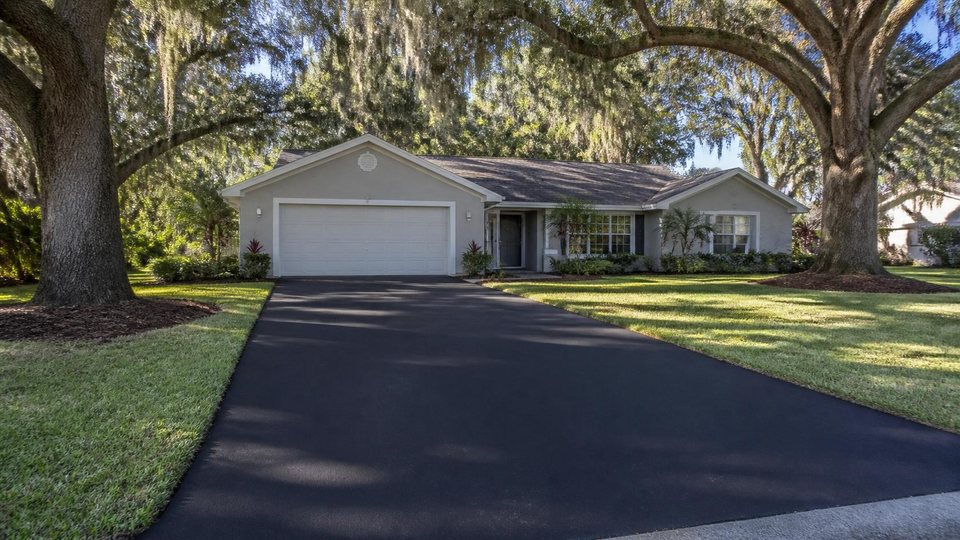
The driveway is the hardest-working surface on a residential lot and often the one laid out with the least thought. A builder installs the width on the plan, runs it straight to the street and moves on. Years later the owners park a third car on the grass, step into wet turf to open a door, and watch water sit against the garage after every storm. Replacing or rebuilding the driveway is the moment to fix those problems instead of copying them.
Asphalt suits Tampa homes for practical reasons. It gives slightly as sandy ground shifts instead of cracking in straight lines, it can take cars within days, and it is simple to extend later with a clean joint. It also asks for things concrete does not: edges that are supported so they do not crumble, and periodic upkeep as sun and heat dry out the binder. The decisions below are the ones that belong to a home driveway specifically.
Ground preparation, base stone and hot-mix rolling are covered in depth on the asphalt paving service page. This page stays on your driveway: its shape and width, where it meets the street, how its edges and drainage are handled, what your association needs to see, and what published ranges say about cost.
Layout and Width Built Around How You Park
Start with how the household uses the driveway on an ordinary weeknight. Count the vehicles that stay overnight, note which ones leave first in the morning, and decide whether anyone needs to get past a parked car to reach the garage. A drive that holds two cars side by side is a different shape from one that stacks them nose to tail, and a family that shuffles cars every morning almost always prefers side by side.
Width is about more than the car itself. People need room to open doors and step onto asphalt instead of turf, carry groceries past a parked vehicle and roll trash bins to the curb. Plenty of drives flare wider near the garage and narrow toward the street, which saves material where extra room does little. On a corner lot or a busy street, a turnaround or backing pad lets drivers leave front first rather than reversing into traffic. Curves look good on a deep lot, but a tight curve makes backing harder and scuffs the asphalt where tires turn in place.
The Apron Where the Driveway Meets the Street
The apron is the stretch between the edge of the road and your property line, often crossing a sidewalk or a roadside swale. It usually sits in public right-of-way, so the city or county has a say in its shape and materials, and work there generally needs a permit. Where a sidewalk crosses the drive, that section is often left in place or rebuilt to the local standard rather than covered with asphalt.
The apron is also where most scraping and ponding complaints begin. The rise from the gutter or road edge up to the driveway has to be gradual enough that a low car does not drag its bumper, yet shaped so street runoff does not run up the apron toward the house. Where the drive crosses a swale, a culvert pipe beneath it keeps the ditch flowing, and a crushed or undersized pipe backs water onto the lot. Where new asphalt meets the road, the old edge should be cut clean and the new mix butted tight against it, since a thin feathered edge breaks away within a season.
Edges and Borders That Hold Up in Sand
Asphalt has almost no strength at an unsupported edge. When the side of a driveway sits on loose sand with nothing beside it, tires that drift off the edge break it away a little at a time, and rain undercuts it from the side. The fix belongs in the install: the edge is compacted as it is rolled, often with a slight bevel, and the soil next to it is backfilled flush and tamped so turf grows right up to the asphalt.
Some owners want a visible border. A poured concrete ribbon along each side gives the edge a hard stop and a crisp line against the lawn. A band of brick or concrete hardscape adds color at the street end, though it needs its own firm base so it does not settle separately from the asphalt beside it. Metal or plastic landscape edging keeps mulch and stone in their beds but does not hold up an asphalt edge by itself. Where a live oak or another large tree stands close to the drive, a root barrier set along the edge slows the lifting that roots cause.
Drainage Away From the House
Every driveway should move water away from the home. The finished surface needs a steady fall from the garage slab toward the street or the side yard, with no low spot at the garage door. When a lot sits below the level of the road, the driveway has to slope toward the house, and the answer there is a trench drain across the drive in front of the garage, piped to a point where the water can discharge safely.
Then follow the water after it leaves the asphalt. Sending it onto a neighbor's lot starts disputes, and sending it into a planting bed along the foundation invites moisture problems. In subdivisions built around retention ponds, lots are graded to carry runoff toward swales and inlets that feed those ponds, and a new or wider driveway should not block that route. Downspouts that empty onto the drive can be extended or piped past it. Before work starts, the contractor should be able to show you which way each part of the surface will drain.
Getting HOA Approval Before Work Starts
Many subdivisions around Tampa have an architectural review committee that must approve driveway changes, which can include replacement, widening and new borders. Treat approval as step one, not paperwork to sort out after the asphalt is down. An association can demand changes to finished work, and some spell out materials, colors or border styles in their guidelines. Read the governing documents first so the plan you get priced is a plan the committee will accept.
A typical application asks for a simple site sketch showing the existing and proposed driveway outline, the dimensions, the material and any border, and sometimes a copy of the contractor's proposal. Committees often meet on a set schedule, so submit early and wait for written approval before locking in a start date. If the project also needs a city or county permit, the two approvals are separate, and having one does not excuse the other.
Driveway Extensions and Parking Pads
Adding width for another car, a side pad for a boat or trailer, or a parking spot beside the garage is one of the most common residential asphalt jobs. The existing edge is saw-cut back to solid asphalt so the new section meets a clean vertical face, and the base under the extension is built and compacted to match the original. A tack coat on the cut face helps the joint hold. Expect the new asphalt to look darker than the old for a while; the difference fades as it weathers.
A pad for a boat, camper or trailer has to handle weight concentrated on small points. A tongue jack or stabilizer leg presses hard on a spot only a few inches across, and new asphalt in summer heat will dent under it. Put a flat board or steel plate under jacks and stands, and ask about a heavier base where something will sit for months at a time. Before extending, confirm with your HOA and the permitting office that the added hard surface is allowed on your lot.
Published Cost Ranges for Tampa Asphalt Driveways
Every figure in this section is a published range drawn from cost guides and a local contractor, not a quote. The contractor who measures your driveway prices the job. For a new asphalt driveway installed in Tampa, the published span is 2.40 to 7.00 per square foot. The low end, 2.40 to 4.00, is what city cost guides print; the high end comes from one Tampa contractor whose own residential band reads 3.00 to 7.00. A full replacement, meaning tear-out, new base and new asphalt, is published at 7 to 13 per square foot. Tear-out and removal alone is published at 3 to 7 per square foot, rising with the thickness that has to come out.
An overlay over a sound driveway is published at 1 to 7 per square foot. The low band, 1 to 3, prices the asphalt layer itself; the higher band, 3 to 7, is what guides quote once preparation is included. A City of Tampa driveway permit is published at 50 to 360, and the sources disagree, so check the current fee with the City of Tampa or Hillsborough County. As for how long it lasts: two Florida contractor sources give 10 to 15 years for a neglected driveway, stretching to 20 to 30 when it is maintained, which is the best argument for getting edges and drainage right the first time.
For worked examples on three driveway sizes and a line-by-line look at a bid, read the Tampa asphalt driveway cost guide before you compare quotes.
What’s Included
- A walk-through of how you park, turn and back out before the layout is set
- Driveway outline and width planned around doors, walkways and trash bins
- Street apron shaped for a gradual rise and a clean joint at the road
- A look at the culvert where the drive crosses a roadside swale
- Tear-out and haul-away of the old driveway when replacing
- Surface slope set to carry water away from the garage and foundation
- Compacted, backfilled edges or a concrete ribbon border
- Saw-cut joints and a matched base for extensions and parking pads
- A dimensioned sketch you can attach to an HOA application
Why It Matters in Tampa
Tampa driveways fail from the side and from below far more often than from wear on top. Sandy soil lets unsupported edges crumble, afternoon storms from June through September test every low spot near a garage, and in newer subdivisions the lot grading that feeds retention ponds leaves little margin for a driveway that sends water the wrong way. Live oaks shade older streets beautifully and push roots under asphalt. Summer heat keeps new asphalt soft long after it looks finished, which matters to anyone parking a boat or trailer. And with so many Hillsborough County neighborhoods under HOA architectural review, the paperwork is part of the driveway job rather than an afterthought.
Asphalt Driveways in Tampa — FAQ
When can I park on my new driveway?
Cars can generally use a new asphalt driveway after 2 to 3 days. The asphalt keeps hardening for weeks after that, and in Tampa's summer heat it stays soft enough to mark, so avoid point loads for several weeks: jack stands, trailer tongues, motorcycle kickstands and even ladder feet can press dents into it. Do not turn the steering wheel while the car is standing still, vary where you park instead of using the exact same tire tracks, and keep heavy delivery trucks off it.
How wide should a two-car driveway be?
There is no single right number, and it pays to measure your own vehicles instead of accepting a standard width. Park both cars side by side where the driveway will go, open every door fully, and mark where a person can step out and walk past without touching grass. Add room for a trash bin or bicycles along one side. That measured width is what the parking area needs, and the section toward the street can narrow if the jurisdiction limits how wide the curb connection may be.
Do I need HOA approval just to replace my driveway the same size?
Often, yes. Many associations treat any exterior change as reviewable, and a replacement can change the color, edge treatment or border even when the outline stays put. Check the architectural guidelines or ask the management company directly. If replacement in kind is exempt, get that answer in writing and keep it with your project records. Widening, adding a parking pad or changing materials is much more likely to need a formal application, and some associations also restrict where boats and trailers can be parked.
Should I overlay my old driveway or tear it out?
On a home driveway the deciding details are often heights, not just condition. An overlay raises the surface, and at the garage slab, the sidewalk crossing and the street that added height either gets milled away or leaves a step that catches water and trips feet. If the drive already sits close to the garage floor level, a new layer can push runoff toward the door. A sound base with good heights suits an overlay; a sunken, broken drive or one with no room to build up usually needs removal.
Can I extend a concrete driveway with asphalt?
Yes, and it is common when a homeowner wants a parking pad beside an existing concrete drive. The two materials move differently, so the joint should be a clean, straight line with the asphalt compacted firmly against the concrete edge, and the base under the asphalt built up to the concrete's level so the new side does not sink. Expect a visible color contrast that will not fade away. Check HOA rules before mixing materials, since some associations want one surface across the whole driveway.
Is asphalt or concrete better for a Tampa driveway?
Each has trade-offs in this climate. Concrete stays cooler underfoot, resists softening under jack stands and usually lasts longer, but it costs more at the start, shows oil stains, and cracks in straight lines when sandy ground settles. Asphalt goes in faster, tolerates slight ground movement, is easy to patch and extend, and cars can use it sooner. It does need periodic sealcoating and gets hot and a bit soft in July. Your HOA guidelines and how long you plan to stay often settle the choice.
Other Services
- Asphalt Paving in Tampa
- Asphalt Repair in Tampa
- Asphalt Sealcoating in Tampa
- Parking Lot Paving in Tampa
Areas We Serve
- Asphalt Driveways in Hillsborough County
- Asphalt Driveways in Brandon
- Asphalt Driveways in Riverview
- Asphalt Driveways in Temple Terrace
- Asphalt Driveways in Lutz
- Asphalt Driveways in Plant City
Wondering what the job runs? See what an asphalt driveway costs in Tampa.
Free Asphalt Driveways Estimate in Tampa
Free, no-obligation estimates across Hillsborough County. Tell us about your driveway or lot.
Call (656) 208-2400