Asphalt Driveway Replacement in Tampa, FL
When a driveway has failed from the base up, another patch or another layer only buys a little time. Here is how to tell when replacement is the honest answer, and what a proper tear-out and rebuild involves on Tampa ground.
Call (656) 208-2400 for a Free Estimate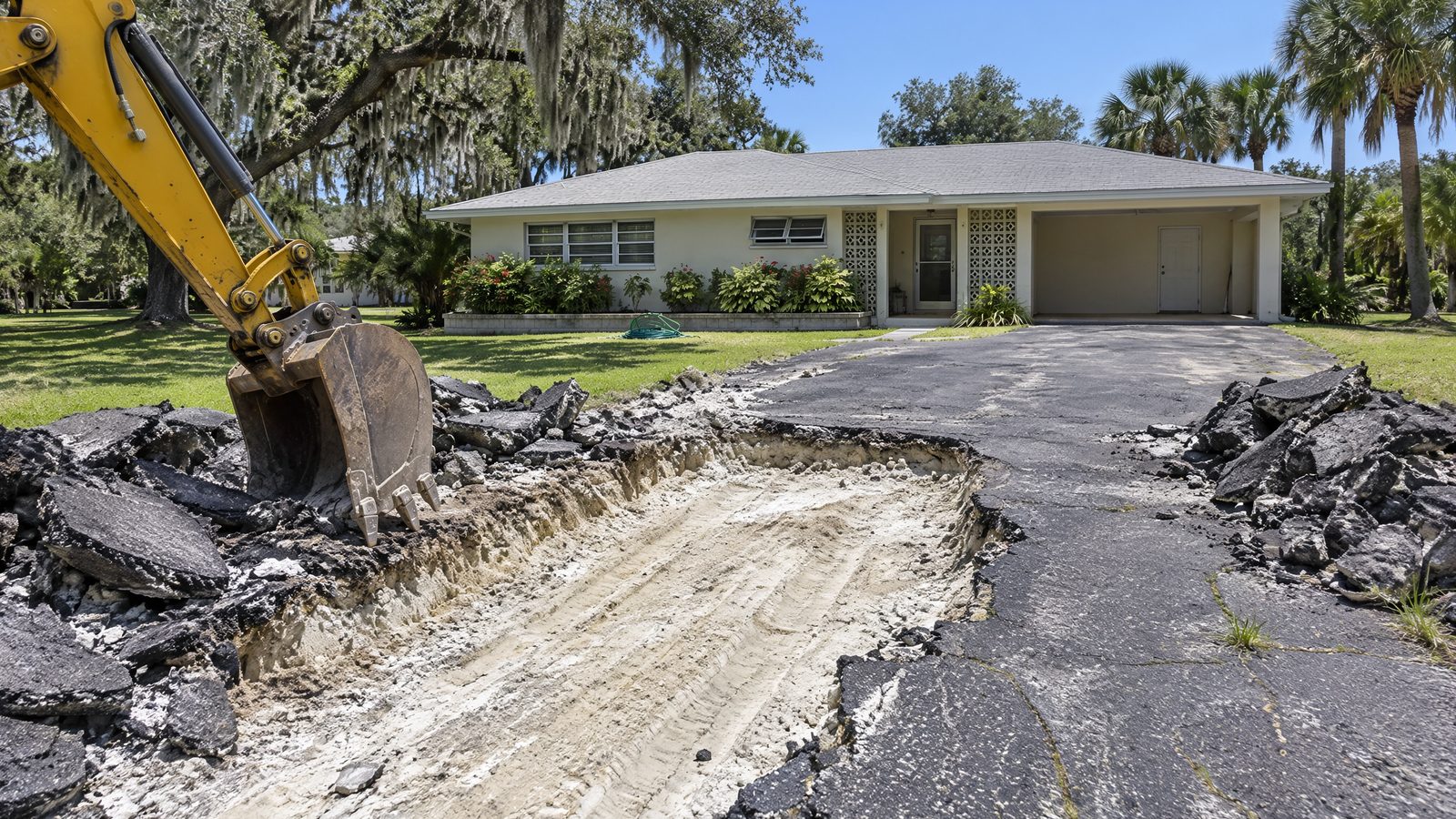
Replacing a driveway is a different job from paving one for the first time. The old asphalt has to come out, and the reason it failed has to be found before anything new goes down. On sandy Hillsborough County soil that reason is usually water: a base that stayed wet through too many rainy seasons, a low corner that never drained, or roots that lifted the surface and let storms in underneath.
Most homeowners reach this page after a few rounds of patching. The cracks come back, the patches sink, and the driveway starts to look like a quilt. That pattern is the clearest sign that the surface is no longer the problem. A new layer laid over a failing base inherits every weakness below it, and the same cracks tend to reappear within a few seasons.
This page covers how to judge whether your driveway really needs replacement, what happens during tear-out and rebuilding, and the local details that decide whether the new drive outlasts the old one.
Replace, Overlay or Repair: Making the Call
Start by looking at how much of the surface is affected. Damage confined to a few spots, like one pothole or a cracked section where a delivery truck turned, is a repair job. Weathered, gray, lightly cracked asphalt over a base that still feels solid underfoot is a candidate for an overlay, which adds a fresh layer without disturbing what is below. Replacement makes sense when the failure is spread across the drive and reaches into the base.
The signs of base failure are consistent. Interconnected cracking that looks like reptile skin covers the areas where cars park and turn. The surface dips or ruts in the wheel paths. Patches placed a year or two ago have already settled. Water stands in the same places after every afternoon storm. Edges crumble away into the lawn. When several of these show up together, the structure underneath has lost its strength, and covering it only hides the problem for a while.
Age matters less than condition. A driveway built on a well-drained, well-compacted base can stay serviceable for a long time with sealcoating and crack filling, while one built thin over soft sand can fail early. An on-site look that includes probing the soft spots and checking where water goes is worth more than a rule of thumb about how old the drive is.
Tear-Out and What It Reveals
Removal is usually done with a skid steer or small excavator that breaks the old asphalt into slabs and loads it for hauling. Clean asphalt is commonly taken to a recycler rather than a landfill, where it is ground up and reused in new mix or base material. Where the driveway meets the garage slab, the sidewalk or the street, the old surface is saw-cut first so the break happens on a clean line and nothing next to it gets damaged.
Tear-out is also the best diagnostic moment of the whole project. With the asphalt gone, you can see what the original builder put down. Sometimes there is a thin skim of stone over loose sand. Sometimes the base is fine and the failure came from one spot where a downspout emptied for years. Sometimes there is old shell, broken concrete or organic debris that was buried instead of removed. What turns up should change the plan, and a crew that looks before rebuilding is doing the job properly.
Rebuilding the Base on Sandy, Wet Ground
The base is what actually carries a car. In this part of Florida it is commonly built from crushed limerock or crushed concrete aggregate, spread in layers and compacted with a roller or plate compactor until it is dense and unyielding. Sand alone does not hold a load well once it is saturated, so any soft or organic material found during tear-out has to come out and be replaced with compacted fill before the base layers go in.
Thickness should follow the soil and the traffic, not habit. A driveway that only ever sees two cars can be built lighter than one that takes a boat trailer, a delivery van or a weekly yard-service truck. Areas where water has collected in the past may need extra depth or a different approach to drainage. The quote should say what base material is being placed and how deep, because that is the part of the job you cannot inspect once the asphalt is on top.
Grade gets set during the base work too. The finished surface needs enough slope to move water off the pavement and away from the house, toward the street, a swale or the yard. On flat lots, that slope is small and easy to get wrong, which is why so many Tampa driveways hold a puddle in the same corner. Checking the grade with a string line or a laser before paving costs little and prevents a new birdbath.
Live Oak Roots, Downspouts and Other Repeat Offenders
Many older neighborhoods across the county are shaded by live oaks, and their roots spread far beyond the canopy. A root growing under a driveway lifts and cracks the surface as it thickens. Cutting a large root can harm or destabilize the tree, so decisions about root pruning belong with an arborist before tear-out, not in the middle of it. Sometimes the better answer is to reroute part of the drive, leave a wider gap at the edge, or accept a slight curve rather than fight the tree.
Water sources deserve the same attention. A downspout discharging onto the driveway edge, irrigation heads that wet the pavement every morning, or a neighbor's yard draining across your lot will undermine a new base exactly as it did the old one. Extending a downspout, adjusting a sprinkler or adding a small swale costs little next to replacing a driveway twice.
The Street Apron, Permits and HOA Review
The part of the driveway between your property line and the road usually sits in the public right-of-way, and work there is regulated. Inside the City of Tampa, Temple Terrace or Plant City the city sets the rules; in unincorporated areas like Brandon, Riverview and Lutz it is Hillsborough County. A driveway that meets a state road falls under the state transportation department instead. The permitting office can tell you the required width, how the apron must meet the curb or roadside ditch, and whether an inspection is needed.
Many subdivisions also require architectural review before an owner changes a driveway, even when the new one keeps the same footprint. Approval can take a few weeks, so it is worth submitting the plan early, along with the material and color if the association asks. Replacement is also the natural time to widen the drive or add a parking pad, and both of those changes are more likely to need HOA sign-off than a straight swap.
Scheduling Around the Wet Season and the First Weeks After
Asphalt is placed hot and compacted while it is still workable, so rain on a prepared base or during paving is a problem. Summer afternoon thunderstorms are predictable enough that many crews start early in the day and plan the paving for the morning. Tear-out and base work can usually proceed between showers, but a base soaked by a downpour may need time to drain before it is ready to pave.
Fresh asphalt stays soft for a while, especially in summer heat. Cars can usually use the drive after a few days, but sharp, concentrated loads leave dents for weeks: jack stands, motorcycle kickstands, trailer tongues, dumpster wheels and even turning the steering wheel while parked. Vary where you park, keep heavy equipment off the edges, and hold off on sealcoating until the new surface has cured, which is generally a matter of months rather than days.
Tear-out, base depth and the size of the drive move the price of a replacement more than anything else. The published ranges for full replacement, removal and new installation are on the Tampa asphalt driveway cost guide. Where the old drive still has a solid base under a worn surface, asphalt resurfacing may do the job for less.
What’s Included
- An on-site check of cracking, settlement, soft spots and where water collects
- A clear recommendation between repair, overlay and full replacement
- Saw-cutting at the garage slab, sidewalk and street before removal
- Tear-out and haul-away of the old asphalt, with recycling where available
- Removal of soft, wet or organic material found under the old drive
- A compacted aggregate base sized to the soil and the vehicles using it
- Grading that moves water off the drive and away from the house
- New hot-mix asphalt placed and rolled to a smooth, tight finish
- Guidance on permits, HOA review and care during the first weeks
Why It Matters in Tampa
Hillsborough County ground is the main reason Tampa driveways fail the way they do. Sandy soil sits over limestone, the water table is close to the surface across much of the county, and most of the year's rain arrives in heavy afternoon storms between June and September. A base that gets wet here often stays wet, and a driveway built thin on loose sand has little margin when it does. There is no freeze-thaw cycle to blame, so a failed Tampa driveway usually points to drainage, base thickness or roots. Replacement is the chance to correct all three at once, which is why the diagnosis during tear-out matters as much as the new asphalt.
Driveway Replacement in Tampa — FAQ
How do I know my driveway needs replacement and not just repair?
Look at how widespread the damage is. A few cracks or one pothole are repair work. Web-like cracking across the parking areas, ruts in the wheel paths, patches that keep sinking and water that stands after every storm together point to a failed base, and that is when replacement is the lasting fix.
Can new asphalt be laid over my old driveway instead?
Only when the base underneath is still solid and the problems are on the surface. An overlay placed over a failing base carries the old cracks and soft spots straight up into the new layer, so it tends to fail early.
What happens to the old asphalt?
It is broken out, loaded and hauled away. Clean asphalt is commonly recycled, ground down and reused in new paving mix or base material rather than sent to a landfill.
Do I need a permit to replace my driveway in Tampa?
Work on the apron in the public right-of-way usually needs one. The City of Tampa, Temple Terrace, Plant City or Hillsborough County handles it depending on where you live, and a drive onto a state road goes through the state. Your homeowners association may also require approval before work starts.
Will replacing the driveway hurt my oak tree?
It can if large roots are cut carelessly. Have an arborist look at any major roots before tear-out. Rerouting part of the drive or leaving extra space at the edge is often better for both the tree and the pavement.
How soon can I park on the new driveway?
Cars can usually go on it after a few days. Avoid sharp, heavy point loads like jack stands, kickstands and trailer tongues for several weeks, especially in summer heat, and wait several months before the first sealcoat.
Other Services
- Asphalt Paving in Tampa
- Asphalt Driveways in Tampa
- Asphalt Repair in Tampa
- Asphalt Sealcoating in Tampa
- Parking Lot Paving in Tampa
- Asphalt Resurfacing in Tampa
- Gravel to Asphalt Conversion in Tampa
- Parking Lot Striping in Tampa
Areas Served
- Driveway Replacement in Hillsborough County
- Driveway Replacement in Brandon
- Driveway Replacement in Riverview
- Driveway Replacement in Temple Terrace
- Driveway Replacement in Lutz
- Driveway Replacement in Plant City
Wondering what the job runs? See what an asphalt driveway costs in Tampa.
Free Driveway Replacement Estimate in Tampa
Free, no-obligation estimates across Hillsborough County. Tell us about your driveway or lot.
Call (656) 208-2400